A quiet revolution is unfolding in how the world transacts. It no longer requires a human to spend time and effort figuring out the best way to send a payment or compare prices. Instead, AI tools like ChatGPT, Claude, and Gemini are learning to do all of that for us. They’re making decisions, comparing options, purchasing services, and settling payments on our behalf. Instantly. Across borders. Without us lifting a finger.
This is what people are calling the agentic commerce economy — and it’s moving faster than most businesses realize.
Think of it this way: today, if you want to buy something online, you open a browser. You then search for what you need, compare prices across a few sites. On finding the best option, you enter your credit card, and hit “buy.” That’s traditional e-commerce — it requires you at every step.
Agentic commerce flips that. Instead of you doing the work, an AI agent does it for you. It finds the product, checks the reviews, compares the prices, picks the best option. An AI agent could also pay — all without you clicking through a dozen tabs. And it doesn’t just work for shopping. These AI agents can handle invoices, vendor payments, subscriptions, and business purchases too.
The biggest companies in tech are already building this. Shopify launched Agentic Storefronts. Millions of merchants can now sell their products directly inside AI chats on ChatGPT, Microsoft Copilot, Google Search, and the Gemini app. Stripe built an Agentic Commerce Suite with OpenAI. Businesses can sell through AI agents with one simple integration.
Google created the Universal Commerce Protocol (UCP) with support from Walmart, Target, Etsy, American Express, Mastercard, and Visa.
Notably, the numbers show where this is heading. McKinsey says agentic commerce could reach $3 to $5 trillion globally by 2030. Bain thinks AI agents could handle 15 to 25 percent of all U.S. online shopping by then.
Adobe tracked a 4,700% jump in AI-driven traffic to merchant websites. And more than 700 AI agent startups launched on Stripe in a single year. This isn’t a small experiment — it’s a new economy being built in real time.
What makes this moment different from past tech hype is that the biggest companies aren’t just talking about agentic commerce. They’re competing to build the underlying plumbing. Think of it like the early days of the internet, when companies fought over which standards would power the web. That same kind of battle is playing out right now for AI-powered commerce.
Google made the first big move at the National Retail Federation conference in January 2026. It launched the Universal Commerce Protocol (UCP). In simple terms, UCP is a shared language that lets AI agents talk to any retailer’s system. They can find products, check prices, complete purchases, and handle returns. All through one standard instead of a different custom setup for every store.
They built it with Shopify, Etsy, Wayfair, Target, and Walmart, and more than 20 other major partners signed on. It includes American Express, Best Buy, Mastercard, Stripe, The Home Depot, Visa, and Zalando. Just this week, Google added new features like multi-item carts, real-time inventory checks, and loyalty program linking.
OpenAI and Stripe built their own standard called the Agentic Commerce Protocol (ACP). ACP powers shopping inside ChatGPT.
Stripe also launched the Agentic Commerce Suite. A simple tool that lets businesses sell through multiple AI agents with one integration. Stripe and Tempo co-authored the Machine Payments Protocol (MPP) for AI-to-AI payments. Visa is already a design partner.
Amazon went the other direction entirely. Instead of joining the open partnerships, Amazon blocked dozens of AI agents — including ChatGPT — from accessing its website. It’s building its own “Buy for Me” feature. This lets Amazon’s own AI buy products from other websites for you, all without leaving the Amazon app.
At NRF 2026, 75% of retailers said they were already building or planning agentic commerce. Target, Sephora, Nordstrom, Lowe’s, Best Buy, The Home Depot, and Wayfair are all integrating early.
OpenAI’s experience with Instant Checkout tells you everything you need to know about where the real challenge lies.
When OpenAI launched Instant Checkout inside ChatGPT, the idea was simple. You could find a product and buy it without ever leaving the chat. Etsy, Walmart, and Shopify all signed up as partners. It sounded like the future.
The reality? It was a mess. Getting merchants set up turned out to be incredibly difficult. The checkout kept hitting errors. Out of the millions of stores on Shopify, only about 30 actually worked with Instant Checkout.
Walmart listed around 200,000 products, but at an investor conference in March, Walmart’s head of AI called the whole thing “a very temporary moment in time.” OpenAI hadn’t even figured out how to collect state sales taxes.
As a result, by March 2026, OpenAI pulled the plug. They stopped trying to handle checkout themselves and shifted to just helping people discover products — letting the retailers handle their own payments. Walmart is now putting its own AI assistant, Sparky, inside ChatGPT. Etsy is building its own ChatGPT app. Shopify merchants will send buyers to their own websites to finish the purchase.
Consider currency conversion, tax rules in different countries, compliance requirements. And the expectation that AI agents will settle payments in seconds across time zones. Now you can see why the old banking system just can’t keep up.
Here’s the core problem: the payment systems we use today were designed for people, not machines.
AI agents don’t take weekends off, and they don’t wait for bank business hours. Instead, they transact around the clock, often in tiny amounts. A few cents for a data request, a fraction of a penny for an API call. The traditional payment system simply wasn’t designed for any of this.
Think about the gaps:
A cross-border bank wire can take 3 to 5 business days. An AI agent needs payment to settle in seconds.
Credit cards charge a fixed fee plus a percentage on every transaction. If an AI agent is paying $0.003 for a data query, a $0.30 processing fee makes the whole thing pointless.
Banks close at night and on weekends. AI agents work 24/7.
Traditional payment systems aren’t designed to plug directly into software. AI agents need to trigger payments through code, not through a checkout page built for humans.
Circle CEO Jeremy Allaire put it well at the World Economic Forum in Davos: the idea of an AI agent pulling out a Visa card or initiating a bank wire just doesn’t make sense for the world being built. We need a way to move money that works at machine speed, at tiny amounts, across any border.
The picture is clear: AI agents need payment rails that are as fast, cheap, and global as they are.
For example, today a freelancer in Rwanda invoicing a U.S. client faces a mess of middlemen, currency conversion fees, and multi-day wait times. A vendor in India billing an American company deals with the same headaches.
Now picture that same payment handled by an AI agent. The agent gets the invoice, checks the work, converts the currency, and settles the payment. All in seconds and at a fraction of the cost. No chain of banks in the middle. No 3-to-5-day wait.
This isn’t science fiction. It’s the direction the entire payments industry is moving.
Meanwhile, at Instarails, we’ve been building payment rails for exactly this future. We serve the use cases that the agentic economy will supercharge.
As AI agents take over more of the payment process, the winners will be platforms built for speed and global reach. Not the ones still running on infrastructure designed for a world where humans filled out wire transfer forms by hand.
At Instarails, we didn’t wait for the agentic commerce economy to arrive — we’ve been building the infrastructure it requires since day one.
Here’s what makes us different: Instarails pays vendors and freelancers in their local currency — directly to their bank account or e-wallet. No crypto wallets. No token conversions. No asking a freelancer in Rwanda or India to figure out how to cash out a stablecoin. The money arrives in the currency they actually use, in the account they already have, in minutes.
That said, we also support stablecoins for clients and corridors where they make sense. But our core value is simple: we meet recipients where they are — whether that’s a BDO account in the Philippines, a UPI wallet in India, a PIX transfer in Brazil, or a mobile money account in Ghana.
Our proprietary payment rails bypass the correspondent banking system entirely. No chain of intermediary banks adding days, fees, and opacity to every transfer. When a payment moves through Instarails, it settles in minutes — directly to the recipient’s local account — across 150+ countries and 70+ currencies.
That’s exactly what AI agents will need. When an autonomous agent processes a vendor invoice from a U.S. company to a freelancer in Rwanda, or triggers a payroll run from Atlanta to a development team in India, it needs rails that are instant, low-cost, and available 24/7.
It can’t wait for a SWIFT wire to clear in 3 to 5 business days. It can’t absorb a 5–9% fee hidden in exchange rate markups. And it can’t rely on systems that shut down on weekends.
Ultimately, whether the payment is triggered by a human accounts payable team today or by an AI agent tomorrow, the infrastructure needs to be the same: fast, cheap, global, and always on. That’s what we’ve built.
The agentic commerce economy isn’t coming. It’s already here. Google, OpenAI, Shopify, Stripe, Amazon, Visa, and Mastercard are all spending billions to build it. Google is onboarding retailers to UCP. OpenAI already learned the hard way that payments are harder than discovery and is retooling its whole strategy. Stripe is building tools so businesses don’t have to bet on one standard. Amazon is going its own way, blocking outside AI agents while building its own walled garden.
Eventually, the protocol wars will sort themselves out. What won’t change is the direction: AI agents are becoming independent economic actors, and they need payment infrastructure that matches their speed, scale, and global reach. The old system — built for humans, running on business hours, moving through chains of middlemen — simply can’t keep up.
The question for every business that works across borders is simple: Are your payment rails ready for a world where the next entity processing your vendor payment might not be a person?
The businesses that can answer “yes” will capture the opportunity. The ones still waiting for a bank wire to clear will get left behind.
Agentic commerce is when AI agents — like those built into ChatGPT, Claude, or Gemini — handle transactions on your behalf. They can find products, compare prices, place orders, and make payments without you having to do the work manually.
Today’s payment systems (credit cards, bank wires, correspondent banking) were designed for people. They’re too slow, too expensive, and too limited in hours for AI agents that need to transact around the clock in tiny amounts across borders.
AI agents handling vendor payments, freelancer invoices, and international procurement need payment rails that settle instantly across borders. That makes slow, expensive correspondent banking increasingly outdated — and platforms like Instarails, built for speed and global reach, increasingly essential.
Instarails already bypasses correspondent banking to enable instant transfers across 150+ countries and 70+ currencies. That infrastructure is built for exactly the kind of fast, low-cost, cross-border payments that AI agents will demand.
UCP is an open standard Google launched in January 2026 that gives AI agents a common language to shop across any retailer — handling product discovery, checkout, and returns through one system instead of separate integrations for every store. It was built with Shopify, Walmart, Target, Etsy, and 20+ other partners.
OpenAI tried to let people buy products directly inside ChatGPT. It struggled with merchant onboarding, checkout errors, and missing tax systems, and was shut down by March 2026. OpenAI now focuses on helping people find products and lets retailers handle checkout themselves — proving that moving money is harder than finding things to buy.
The main ones are Google’s UCP, OpenAI and Stripe’s ACP, Stripe and Tempo’s Machine Payments Protocol (MPP), and card network approaches from Visa and Mastercard. There’s also Amazon’s walled-garden “Buy for Me” approach. The standards are still being sorted out, but the direction is clear: AI agents need payment infrastructure that’s fast, programmable, and works everywhere.

April 18, 2026
Struggling to Get Paid in Ghana? Here’s Why — and What Works














From startups to enterprises, businesses trust Instarails to move money across borders — instantly and affordably.
"Switching to Instarails for invoicing our U.S. clients was a game-changer. We used to get poor FX and on top of that, bank charges were eating into every payment. It was silently adding up to around 15% loss on every transfer. Now with Instarails, we get the live exchange rate, zero surprises on charges, and the money hits our account in under 30 minutes. It's faster, cheaper, and honestly just simpler. Highly recommend Instarails to any tech company in India billing U.S. clients."
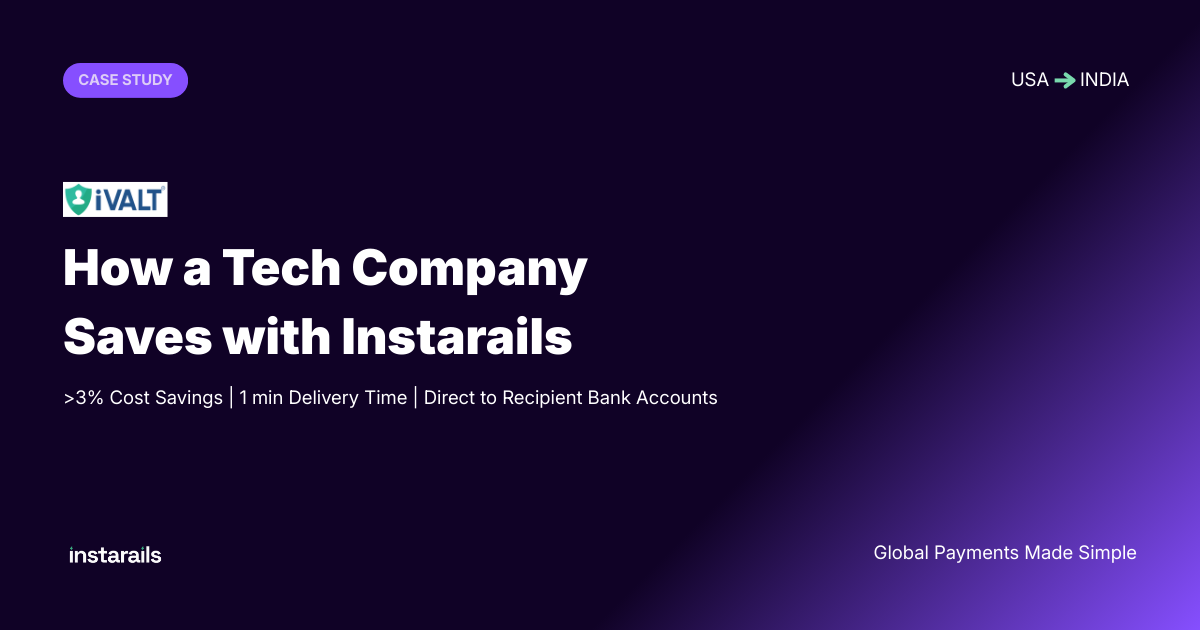
" Instarails has transformed how we handle international payments. Their platform saves us at least 3% in costs, directly improving our bottom line. The batch upload feature streamlines our processes, but what's most impressive is the impact on our overseas team — they now receive their full salaries directly in their bank accounts in under one minute, with zero deductions."
"We recently ran into an issue where both of our overseas payment platforms went down at the same time, and we needed a fast solution to pay our global team. The setup with Instarails was simple, smooth, and the payments were lightning fast. Huge relief on our end. Definitely recommend Instarails to any employer looking for a reliable way to pay international team members without the headaches."
"What sold me on Instarails is that I don't deal with a wallet at all. My US clients send payment and it arrives directly in my Fidelity Bank Ghana account as GHS — instantly, at the best FX rate I've seen. Before, I was waiting days for SWIFT transfers to clear and losing over 5% to fees and poor conversion rates. Now the money arrives in minutes, ready to use — and because it's sitting in my bank account, not a wallet, I'm actually earning interest on it. It's changed how efficiently I run my travel business."
"Instarails onboarded us in five minutes. Our US clients pay us and the money lands in our bank account almost instantly. The fees are a fraction of what we used to pay, and we get market exchange rates. No more waiting days or losing money to mystery charges. It's the easiest way we've ever gotten paid."
"As a freelancer working with U.S. clients, I used to dread payment day. Between bank wire fees and terrible exchange rates, I was losing approximately 3% on every invoice. On a $10,000 project, that's $300 — almost ₹25,000 — just vanishing. Since I started using Instarails, everything changed. I send my invoice, my client pays, and the money hits my account instantly at the best FX rate with the lowest fees. Plus, I get a proper invoice for my records. "